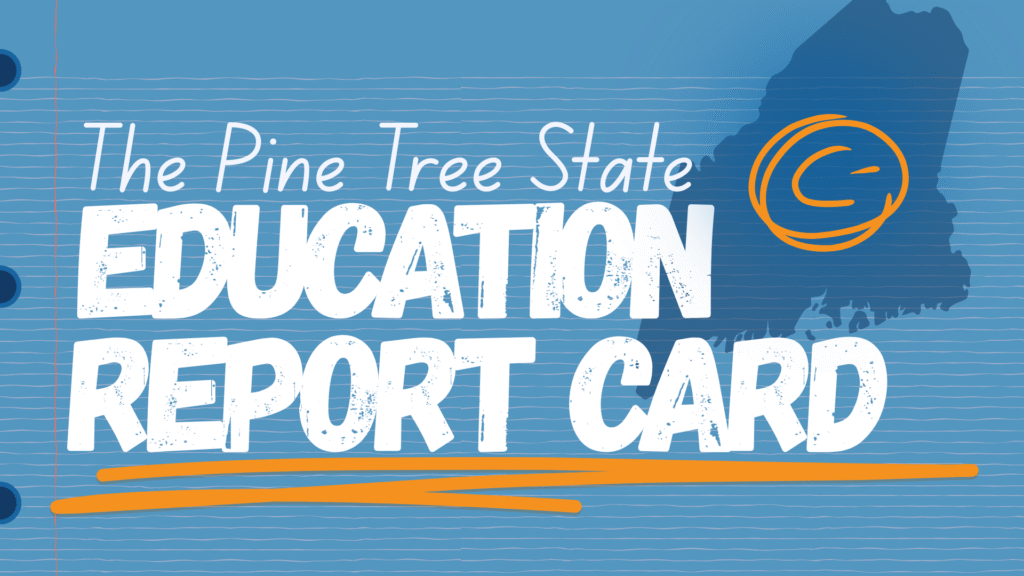
The Pine Tree State: Overall C-
Maine’s oldest school choice tool, Town Tuitioning, only reaches families whose town has no public school at their grade level. A charter cap that is already full, and a Human Rights Act rewrite that sidesteps a Supreme Court ruling, keeping choice narrow. Maine does far better on the ground floor, with an easy path for microschools to open and broad homeschool access, but public dollars rarely follow the student.
Microschools — B
Microschools are small independent schools, typically around 15 students, that run differently from a traditional classroom. Most are opened by teachers with public and private school experience. Maine offers one of the easier paths to open in the country.
- Microschools can open under Maine’s equivalent instruction law with one annual letter to the commissioner. No certification or curriculum approval required.
- Zoning is decided town by town. Maine has no statewide rule protecting small schools in residential areas.
- A microschool that wants Town Tuitioning dollars must switch to the heavier approved-school track, requiring certified teachers or accreditation.
Improvements
- Remove the state approval process for Town Tuitioning dollars.
School Choice Policy — D-
School choice covers a wide range of laws: charter schools, open enrollment, and public funding that follows a student to private tuition or homeschooling. One newer tool nationally is the Education Spending Account (ESA), covering tuition and curriculum. Maine has none of the newer tools, and its oldest one comes with strings attached.
In 2022 the US Supreme Court struck down Maine’s ban on religious schools for their town tuitioning program in Carson v. Makin. However, the state rewrote it’s Human Rights Act effectively barring religious schools again. This is still going through the appeals process.
- Town Tuitioning, running since 1873, pays private tuition for students in a town without a public school at their grade level. No other school choice programs exist.
- Charter schools are capped at 10 statewide, and the cap is full.
- Transferring to a public school outside a family’s district requires two superintendents to agree and either can block it.
Improvements
- Reverse the Human Rights changes that prohibits most religious schools from participation in the Town Tuitioning Act.
- Remove the charter cap
- Remove the superintendent approval process on open enrollment transfers in public schools.
Homeschooling — C
Homeschooling is more than a parent teaching at the kitchen table. Parent-led instruction is common with younger children, and many families lean on co-ops, online courses, part-time schools, or in-person classes as kids get older. Maine treats it as a serious legal category with real paperwork.
Homeschooling grew from 3.6% of Maine students in 2019-2020 to 6.4% in 2024-2025.
- Parents file an initial notice with the superintendent and the state, then a yearly continuation letter
- Homeschooled students get access to public school classes, sports, and extracurriculars, plus free dual enrollment in college courses.
Improvements
- Drop the mandatory yearly assessment and
- Remove the annual renewal notice
Extra Credit: Homeschool college access
Maine’s Free College Scholarship, launched in 2022 covers full tuition at any Maine community college for graduates. While we do not support subsidizing higher education. Maine gets a little credit for including homeschoolers in this program.
—
Helpful Links for Parents
- Homeschoolers of Maine (HOME)
- Maine DOE: Equivalent Instruction Private Schools
- Maine DOE: Private School Approval
- Maine DOE: School Enrollment and Transfers
- Maine Charter School Commission
- EdChoice: Maine Town Tuitioning Program
This is part of a series where we review and rate education access in every state in the country. Get more information here.
Author: Jon England is the Senior Education Policy Analyst at Libertas Institute. He is a fourteen-year veteran of public schools. He taught both fifth and sixth grades, receiving Weber District’s E+ Team Award. He proudly homeschools his children with his wife.
Jon received his bachelor’s degree in elementary education from the University of Utah and a master’s degree in educational leadership from Western Governors University. He spent time in the Marine Corps and separated as a sergeant in 2006.
During his time in public schools, Jon increasingly understood the importance of parental empowerment in education. This increased understanding led him to join Libertas to provide educational freedom for families. Jon enjoys spending time with his wife and five children traveling, skiing, and playing games.
Published: July, 2026