Poll: Utahns Support Alternatives to Legal Services

Libertas Institute just released our first Libertas Insights/Overton Insights poll, gauging how Utahns feel about their state and various policy issues. You can explore the full results here.

Affordable Legal Service Alternatives

In Utah, the typical cost of an attorney is around $300 an hour. In the first Libertas Institute/Overton Insights poll, we asked Utahns about their opinions on legal services alternatives. Nearly seven in ten Utahns (69%) say they would consider using a trained paraprofessional or community justice worker for routine legal tasks if it meant lower costs. Twenty-four percent say that it would depend on the task. Only 5% of Utahns said they would not use this option if it were available. 
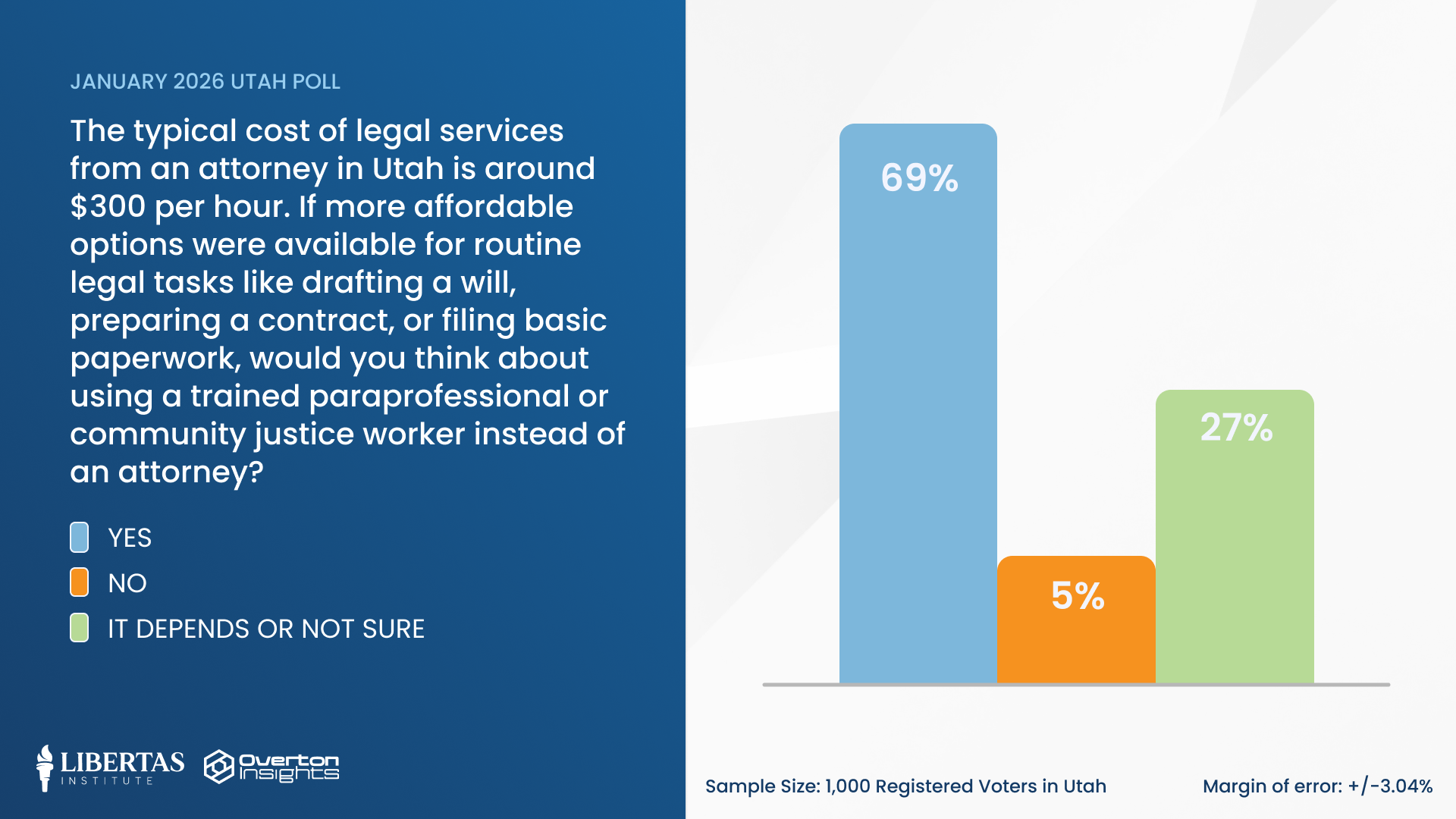
Voters are signaling that for basic needs like wills, contracts, or paperwork, affordability and access matter more than an official job title. This shows a strong appetite for practical, lower-cost legal options that open the door to help people in need. Expanding these alternatives can make everyday legal services more accessible without sacrificing quality or consumer protection.


Author Profile Image
About the author

Jason Chipman

Jason directs Libertas’ public policy efforts with state government. Before joining Libertas, Jason spent 8 years as a member of the Missouri House of Representatives. He received bachelor’s degrees in Organizational Leadership from Drury University and Accounting from Central Methodist University. Jason worked for a semiconductor supply company for 14 years before getting elected, wearing many different hats in that time. He also spent 5 years in the US Navy, completing two deployments to the Persian Gulf aboard the USS John F. Kennedy CV-67. Jason and his wife Elane home school their five children and enjoy traveling and hiking.

Share Post:

Fighting for a Future Where Individuals Are Fully Liberated to Pursue Their Dreams, Free from Coercion and Control.

You Might Also Like

Doomsday AI job predictions keep missing while unemployment holds steady. Why Utah lawmakers should champion innovation over speculative fear.
Utah pays $78,585 per prisoner yearly, yet free therapeutic communities with proven results sit unused because state law offers no pathway into them.
The federal minimum wage is largely irrelevant in 2026—market wages sit far above it, and high wage floors tend to cut hiring for the least-skilled.

Help us Nail and Scale Policies to Reduce Government Control

Your tax-deductible contributions to Libertas Institute increase freedom across the country.