In The News
This past week, the average 30-year fixed mortgage rate hit 7.45%. Moves like this routinely reignite debate over housing affordability and the role interest rates play in high monthly payments.
So how worried should we be about interest rates?
Here’s My Take
First, we have to recognize that a 7.45% mortgage interest rate is historically normal. Compared with the 10–15% rates common through much of the 1980s, it’s quite reasonable. In short, 7.45% only feels high compared with the extraordinarily low 3–4% rates of 3–6 years ago.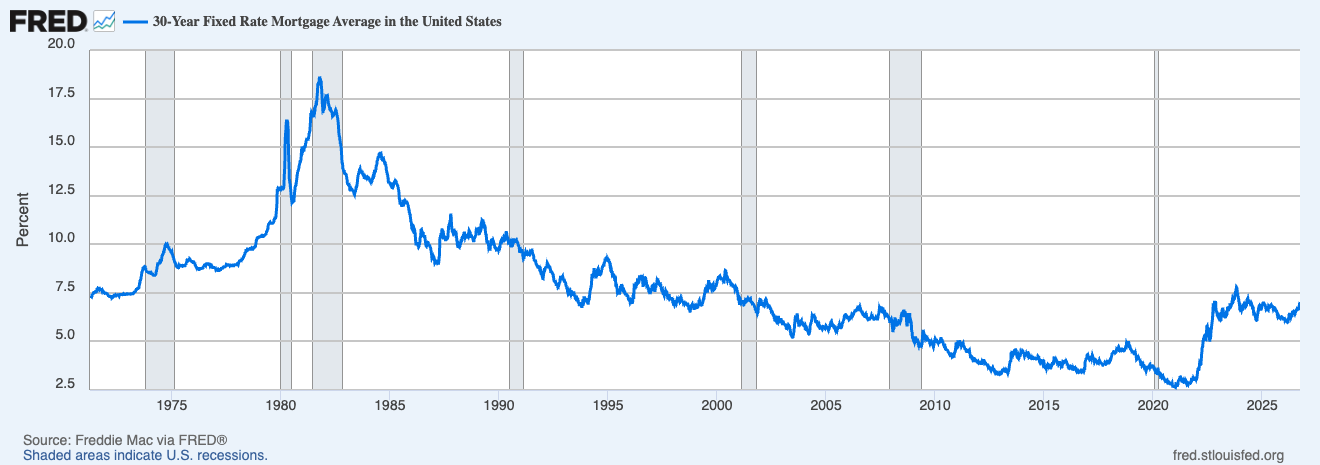 But interest rates are only half the story of a mortgage. The other half is how much money you have to borrow.
Consider 1985. The median single-family home sold for $75,500, while mortgage rates averaged 11.74%. A modest $60,000 house would have required roughly $23,000 in annual income under the standard affordability formula used at the time.
That was roughly what a police officer, nurse, or electrician earned at the time. In other words, an ordinary middle-class job could put a home within reach on one income, even with a double-digit mortgage rate.
Now consider Utah today. Despite the increase in homes for sale, the median single-family home still costs about $559,900. Even if mortgage rates somehow fell back to 4%, a buyer would still need roughly $105,000 in annual income to qualify for the mortgage. At 7.45%, the income required to qualify rises to about $150,000.
There is a popular real-estate saying, “Date the rate, marry the house.” However, that advice only works if you can actually afford to marry the house.
In Conclusion
Lower mortgage rates would unquestionably give buyers some relief. But relying on a return to historically unusual 3–4% mortgages is not much of a strategy for young families today.
For Utah, the affordability conversation cannot stop at the cost of borrowing. It also has to ask why the amount being borrowed has become so large, and what government barriers exist to producing smaller, more modest homes in the first place.