
Many Americans talk as if they live in a Charles Dickens novel, scraping by in economic squalor.
Social media is filled with discussions about the cost-of-living crisis, arguing that it’s near-impossible to survive in modern America. The frustration that many feel isn’t made up; our monetary system has widened inequality due to recent inflation.
This reduction in purchasing power in effect transfers wealth up to those who already had assets at the expense of everyday working Americans. But even in spite of this, the United States remains the easiest country on earth in which to get rich, rivaled only by a handful of places like the United Arab Emirates and Singapore.
The gap is not even close. The global median income is $9.65 a day, or just over $3,500 a year, per World Bank data. Meanwhile, according to the Bureau of Labor Statistics, the median wage in the U.S. exceeds $64,000. That means that the typical American earns in twelve months what the median worker worldwide takes roughly 18 years to make. Even the European Union’s median salary sits near $45,000.
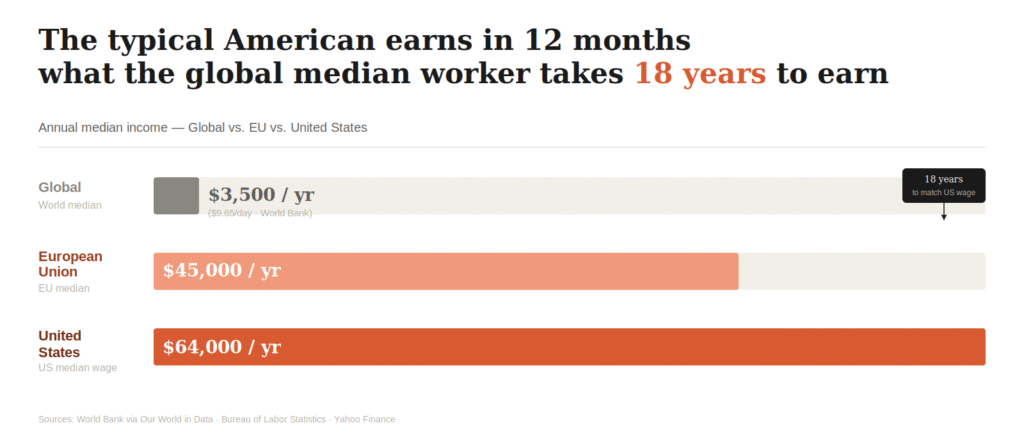
This changes what an ordinary person can do. An American living below his means can accumulate globally significant capital that would be unattainable almost anywhere else. They can then put it to work to build more. With a little Dave Ramsey discipline, real wealth can be accumulated surprisingly fast.
Many assume that quality of life is higher in Europe because of its social safety nets. In reality, countries that heavily tax their citizens to fund welfare programs can’t compete with the United States on wealth or flexibility. They pull resources away from their most productive uses and lock them into initiatives that no citizen can opt out of.
America does the opposite. It leaves the money with the people who earned it, and that optionality changes everything. An American who dislikes the rules in one place can move their capital to whichever of fifty states offers a lighter tax burden, or leave the country entirely for wherever treats them best. It’s better to be rich enough to leave than dependent on a system that taxes your productivity away.
The crowd often insists that saving is impossible in modern America. The numbers disagree. After taxes, the median single worker keeps over $51,000. Meanwhile, the Census Bureau reports that monthly housing costs run around $1,400 for renters or $2,000 for owners with a mortgage. That leaves the typical American between $27,000 and $34,000 for everything else. That’s a lot of Chipotle burritos.
Some places, like California, do have outrageous rents. The fix there is to liberalize zoning, but it’s also important to note that homeownership was never the only road to wealth. Historical data reveals that in many circumstances, renters who invest the difference can finish ahead. Even under punishing housing costs, the American Dream persists; it just takes a different route.
If the economic crisis and inflation were as dire as the posts claim, DoorDash would have collapsed by now, with Americans rediscovering self-reliance and rejecting the division of labor. Instead, the orders keep coming and Americans continue to earn some of the highest wages on earth.
That being said, the United States should aspire to be as competitive as possible, and that means having an even more friendly business environment and reducing taxes even more.